


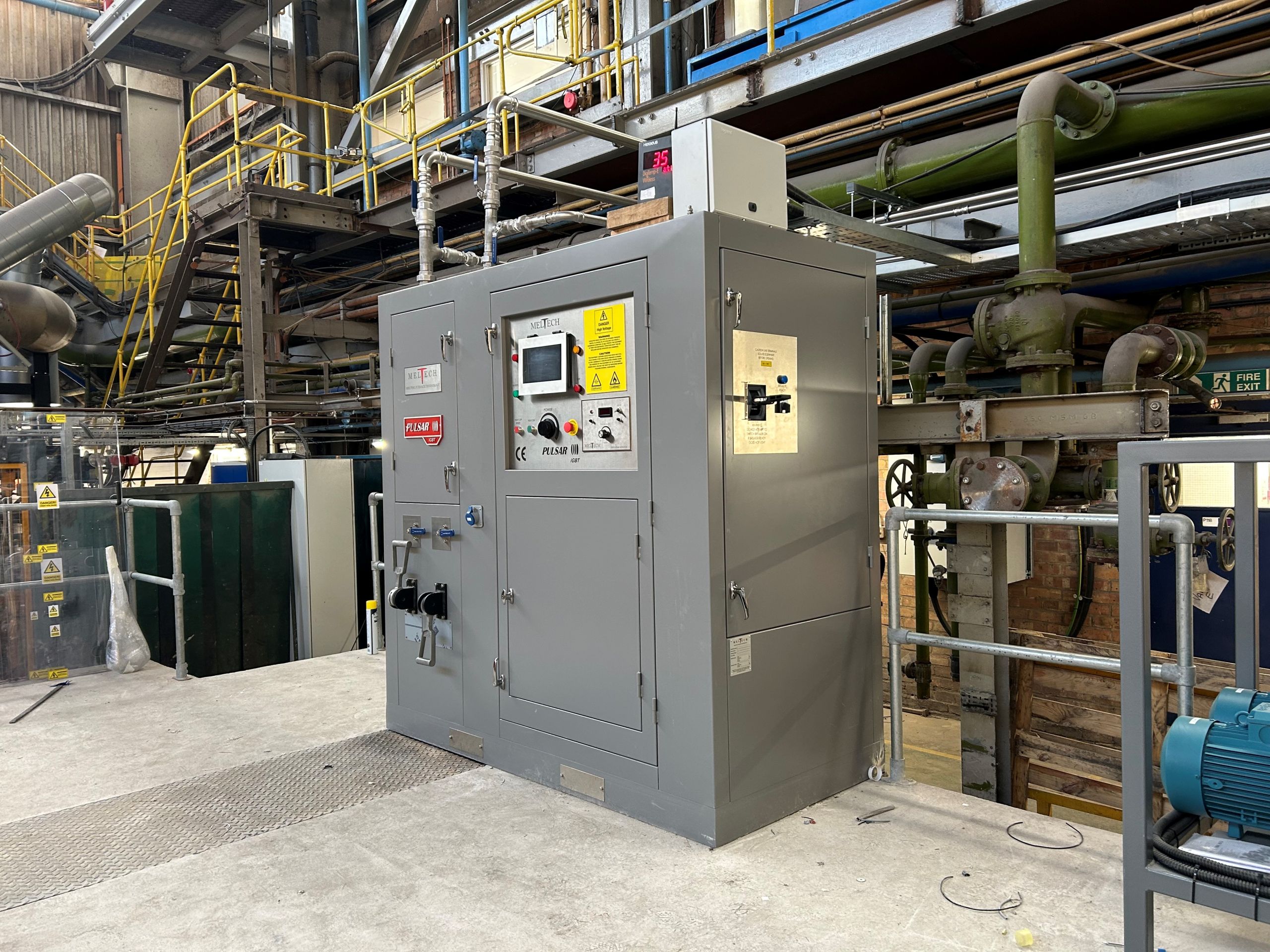
Materials Processing Institute acquires a cutting-edge induction furnace.
Materials Processing Institute (MPI) is a Research and Technology Organisation (RTO) that supports innovation for a sustainable future through materials development and process improvements. This is delivered by project teams at its site in Middlesbrough, UK where it has state-of-the-art equipment, laboratories, workshops, demonstration, scale-up and production facilities.
Research, development, and innovation is focused on advancing materials and process performance, achieving industrial decarbonisation, deploying new digital technologies, and developing a circular economy. Industries supported include steel, metals and alloys, chemical processes, aerospace, defence, energy, concrete and cement, mining and quarrying, construction, rail, transport, and infrastructure, offshore, subsea, and nuclear.
MPI works with its clients direct and through collaborative projects. This includes high quality primary and secondary steel melt development and production in their Green Steel Research and Production Centre.
The primary melting capability is an Electric Arc Furnace (EAF). Secondary steelmaking facilities include ladle furnace and vacuum tank degassing, enabling a wide range of steels to be produced from conventional carbon/manganese grades, through to and including some complex steels.
To support ongoing research and production, MPI has increased its range of furnaces following the recent £500,000 investment in a self-contained 1000kg induction furnace and ancillary equipment. This new furnace incorporates the latest fast melt technology and means that the Institute now has furnaces with melt capability ranging from laboratory scale through to 7 tonnes using its Electric Arc Furnace (EAF).
This new induction furnace will be used to support ferrous and non-ferrous metals research and also used for commercial melts of up to 1 tonne. MPI says that the furnace increases the range of its melting capability and makes scale up research and development more cost effective. Research activities that this furnace will be used for includes steel grade development, and low carbon slag development. Additionally, it will be used for melting services for clients including assay melts and consolidation melts.
This brand-new induction melting furnace to replaces an aging old style 500kg thyristor driven system which was limited in capacity melt rate and efficiency. By mid-2024 the specification for the furnace had been established with offers from several leading furnace manufacturers under consideration.
The selection criteria was a systematic approach, and detailed consideration was given to performance, efficiency and reliability, as well as price. In essence the systems on offer varied greatly in specification requiring detailed assessment of tenders submitted along with qualification of exact capabilities, prior to the furnace selection being made.
In August 2024 MPI awarded the supply and installation contract to Meltech Ltd for a 350kW Pulsar IGBT transistorized inverter driving a 1,000kg Steel capacity Mag-Melt tilting body complete with lip fume extraction ring, hydraulics, water cooling, Installation and refractory push out. As some smaller melts were still required the inverter was matched into an older historic tilting body to allow smaller melts when required. Civils and power supply infrastructure was handled in house using local contractors.
As Brian Wright, Head of Capital Projects at MPI) explains: “Assessing the differing technologies was essential to fully understand what the suppliers were offering and to be certain that what we selected met the specification criteria. The tender from Meltec Ltd met all the requirements and although not the cheapest, essentially you get IGBT technology which was our go to choice plus other features as standard with no additional costs involved. This includes HMI data logging, a feature that lends itself to recording process data when doing assay work or high-grade scale up melts”.
This furnace was installed and commissioned in February and March 2025 and now fills the Institute’s capacity gap between the 7000kg EAF and the smaller vacuum and air melt furnaces.
This investment has been undertaken with support from the Innovate UK funded Foundation Industries Sustainability Consortium (FISC) EconoMISER programme. FISC brings together global leaders in innovation, research, and technology to revolutionise sustainability across the Foundation Industries – the Materials Processing Institute is a member of the FISC consortium along with CPI, Glass Futures, Henry Royce Institute and Lucideon.